News & Topics
Professor Makoto Takeda to Deliver a Lecture at the Special Session of the 4th COVID-19 Research Meeting and the 1st Pandemic Virus Research Meeting
Professor Makoto Takeda to Deliver a Lecture at the Special Session of the 4th COVID-19 Research Meeting and the 1st Pandemic Virus Research Meeting
For details of the special session, please visit:
https://pub.confit.atlas.jp/ja/event/covid26/content/special
Special Session 3 (Co-sponsored by the Japan Society for the Promotion of Science (JSPS) International Leading Research Program)
July 9 (Thu), 13:45–14:15
Makoto Takeda, M.D., Ph.D.
Department of Microbiology, Graduate School of Medicine, The University of Tokyo
Expansion of Canine Distemper Virus Infection in Primates and Acquisition of Human Receptor Usage
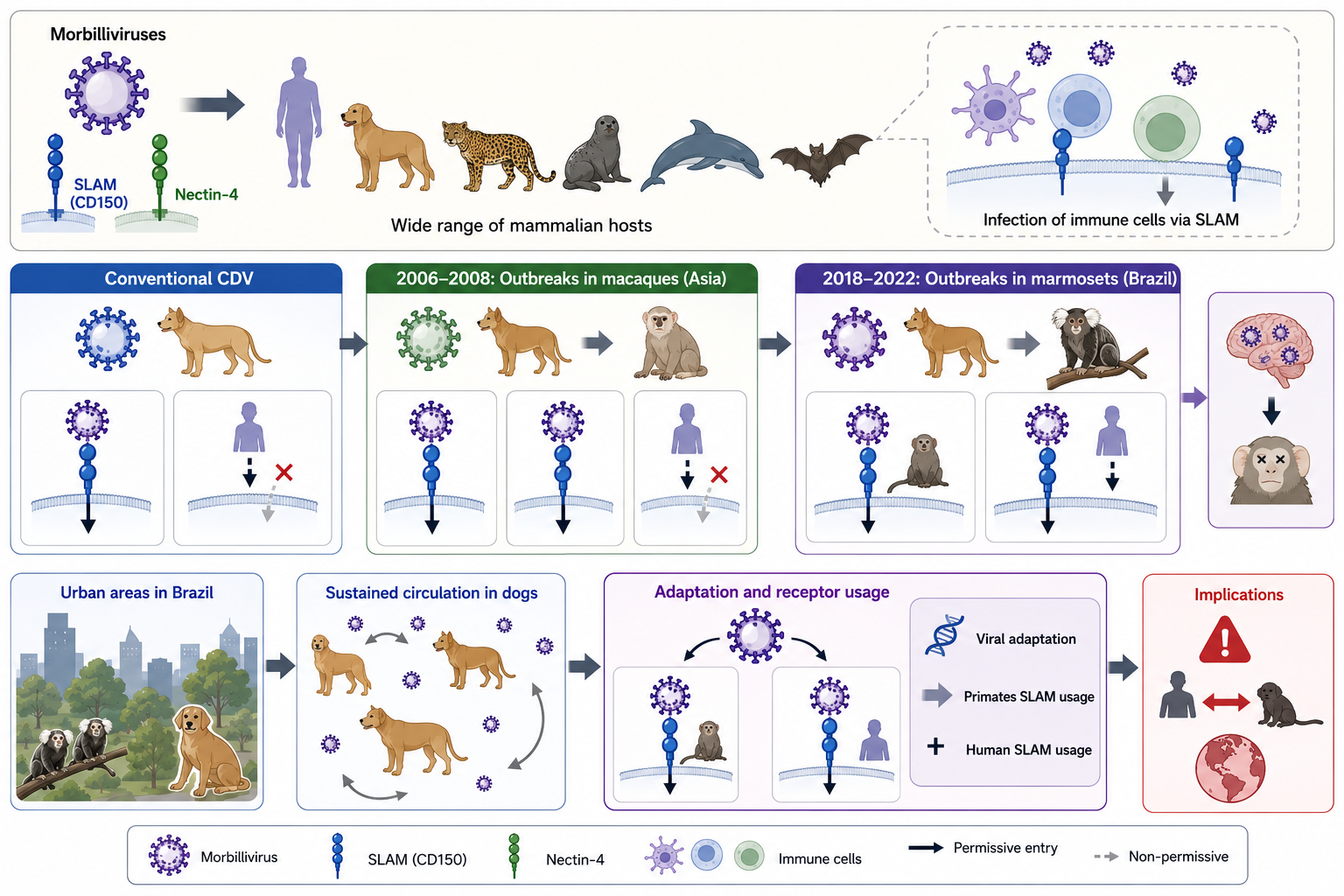
Measles virus is a highly contagious and pathogenic human virus belonging to the genus Morbillivirus within the family Paramyxoviridae. A defining feature of measles virus is its use of the signaling lymphocytic activation molecule (SLAM, also known as CD150) as its cellular receptor, enabling efficient infection of immune cells. In addition to measles virus, the genus Morbillivirus includes numerous viruses that infect a wide range of mammalian species.
Among them, canine distemper virus (CDV) primarily infects canids but has expanded its host range in recent decades to include many other carnivores, including large felids. Between 2006 and 2008, fatal outbreaks of CDV infection occurred in macaques in both China and Japan. Our subsequent studies demonstrated that CDV possesses the ability to utilize macaque SLAM as an entry receptor, providing a molecular explanation for these outbreaks. In contrast, conventional CDV strains are unable to utilize human SLAM, and therefore the risk of human infection has generally been considered low.
However, between 2018 and 2022, at least two fatal outbreaks of CDV-associated acute encephalitis were reported in marmosets in Brazil. Wild marmosets are abundant in urban areas of Brazil and frequently inhabit environments in close proximity to humans. These regions are also endemic for canine distemper in domestic dogs, raising the possibility that sustained circulation of CDV has promoted viral adaptation to marmosets.
Our analyses revealed that conventional CDV strains cannot utilize marmoset SLAM, whereas the Brazilian outbreak strains have evolved efficient utilization of marmoset SLAM. Remarkably, these strains have simultaneously acquired the ability to utilize human SLAM. These findings indicate that the Brazilian outbreak viruses represent a distinct group of CDV variants that have adapted to primate SLAM receptors, distinguishing them from conventional CDV strains.
In this lecture, I will present our findings on the receptor usage and host adaptation of these marmoset-adapted CDV variants and discuss their implications for the emergence of morbilliviruses with expanded primate host tropism.


Category
Archive
- 2027-12 (1)
- 2026-11 (1)
- 2026-10 (2)
- 2026-9 (3)
- 2026-8 (3)
- 2026-7 (3)
- 2026-5 (2)
- 2026-4 (1)
- 2026-3 (6)
- 2026-2 (1)
- 2026-1 (1)
- 2025-12 (3)
- 2025-11 (4)
- 2025-10 (4)
- 2025-9 (3)
- 2025-8 (2)
- 2025-7 (1)
- 2025-6 (5)
- 2025-5 (3)
- 2025-4 (4)
- 2025-3 (3)
- 2025-2 (4)
- 2025-1 (1)
- 2024-12 (4)
- 2024-11 (5)
- 2024-10 (4)
- 2024-9 (6)
- 2024-8 (5)
- 2024-7 (1)
- 2024-6 (2)
- 2024-5 (3)
- 2024-4 (1)
- 2024-2 (2)
- 2024-1 (3)
- 2023-12 (3)
- 2023-11 (1)
- 2023-10 (1)
- 2023-9 (4)
- 2023-8 (3)
- 2023-7 (2)
- 2023-6 (4)
- 2023-5 (1)
- 2023-4 (6)
- 2023-2 (3)
- 2023-1 (1)
- 2022-12 (3)
- 2022-11 (1)
- 2022-10 (3)
- 2022-9 (2)