News & Topics
Join Our Luncheon Seminar: "Measles Virus and Current Challenges in Measles Control" Speaker: Professor Makoto Takeda
Luncheon Seminar: Measles Virus and Current Challenges in Measles Control
A luncheon seminar entitled "Measles Virus and Current Challenges in Measles Control" will be presented by Professor Makoto Takeda, Department of Microbiology, Graduate School of Medicine, The University of Tokyo, during the 30th Annual Meeting of the Japanese Society for Vaccinology / 67th Annual Meeting of the Japanese Society for Clinical Virology.
As measles has re-emerged as a global public health concern in recent years, this seminar will provide an accessible overview of the latest advances in measles virus research, current vaccination strategies, infection control measures, and future challenges in measles prevention and elimination. Healthcare professionals, researchers, public health officials, and all interested participants are warmly invited to attend.
Date & Time: Saturday, September 26, 2026, 12:05–12:55
Venue: Room 6 (Conference Room 201, 2F), Toki Messe Niigata Convention Center
Chair: Dr. Tomohiro Katsuta, Associate Professor, Department of Pediatrics, St. Marianna University School of Medicine
Speaker: Professor Makoto Takeda, Department of Microbiology, Graduate School of Medicine, The University of Tokyo
https://shinsen-mc.co.jp/vac-cv2026/seminar.html
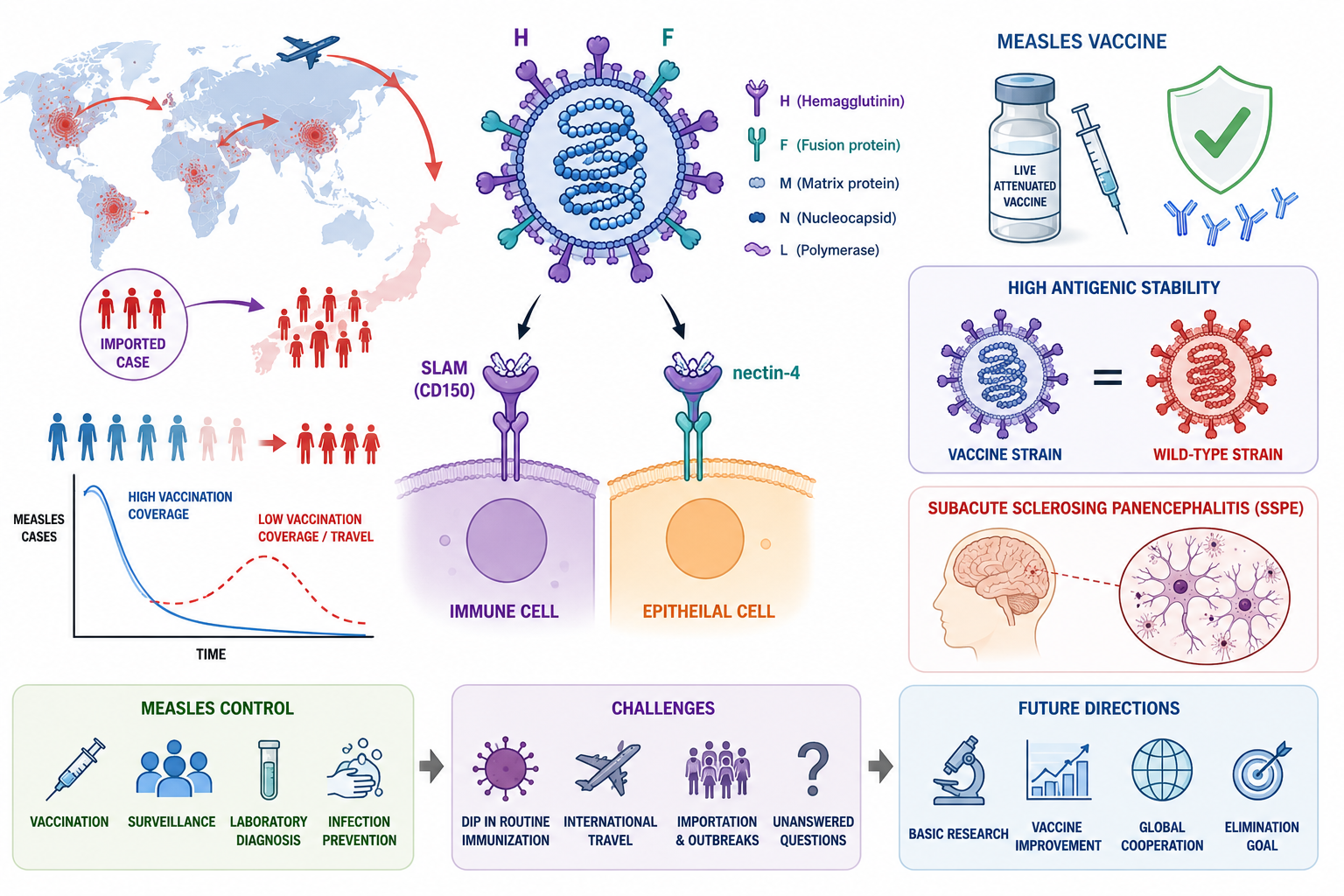
Measles is one of the most representative vaccine-preventable infectious diseases, yet outbreaks continue to occur worldwide. The World Health Organization (WHO) has long pursued global measles elimination, and substantial progress has been achieved in many countries. However, disruptions to routine immunization during the COVID-19 pandemic, together with the resurgence of international travel, have resulted in a renewed increase in measles cases in recent years. In Japan, repeated outbreaks have been triggered by imported cases, and as of June 3, 2026, a total of 523 cases had already been reported. These developments underscore the renewed importance of strengthening measles control.
Over the past decades, considerable progress has been made in understanding the biology of measles virus, including its use of the immune cell receptor SLAM (CD150) and the epithelial cell receptor nectin-4 for host entry, as well as the molecular mechanisms by which it evades innate immune responses. Fortunately, the currently used measles vaccine has maintained remarkably high effectiveness for more than half a century, and no clinically significant antigenic differences have emerged between vaccine strains and circulating wild-type viruses. Nevertheless, it remains unclear why measles virus has preserved such extraordinary antigenic stability and whether this favorable situation will continue in the future. In addition, the pathogenesis of subacute sclerosing panencephalitis (SSPE), a rare but fatal neurological complication of measles, remains incompletely understood.
More recently, canine distemper virus (CDV), a close relative of measles virus within the genus Morbillivirus, has been shown to expand its host range to non-human primates, causing fatal infections in marmosets. Furthermore, these viruses have acquired the ability to utilize the human SLAM receptor, raising important concerns regarding cross-species transmission and host adaptation among morbilliviruses.
In this lecture, Professor Takeda will review recent advances in measles virus research, discuss the current status of measles control and the remaining challenges toward global elimination, and present future directions for research aimed at improving our understanding and prevention of this important infectious disease.


Category
Archive
- 2026-9 (2)
- 2026-8 (3)
- 2026-7 (3)
- 2026-5 (2)
- 2026-4 (1)
- 2026-3 (6)
- 2026-2 (1)
- 2026-1 (1)
- 2025-12 (3)
- 2025-11 (4)
- 2025-10 (4)
- 2025-9 (3)
- 2025-8 (2)
- 2025-7 (1)
- 2025-6 (5)
- 2025-5 (3)
- 2025-4 (4)
- 2025-3 (3)
- 2025-2 (4)
- 2025-1 (1)
- 2024-12 (4)
- 2024-11 (5)
- 2024-10 (4)
- 2024-9 (6)
- 2024-8 (5)
- 2024-7 (1)
- 2024-6 (2)
- 2024-5 (3)
- 2024-4 (1)
- 2024-2 (2)
- 2024-1 (3)
- 2023-12 (3)
- 2023-11 (1)
- 2023-10 (1)
- 2023-9 (4)
- 2023-8 (3)
- 2023-7 (2)
- 2023-6 (4)
- 2023-5 (1)
- 2023-4 (6)
- 2023-2 (3)
- 2023-1 (1)
- 2022-12 (3)
- 2022-11 (1)
- 2022-10 (3)
- 2022-9 (2)